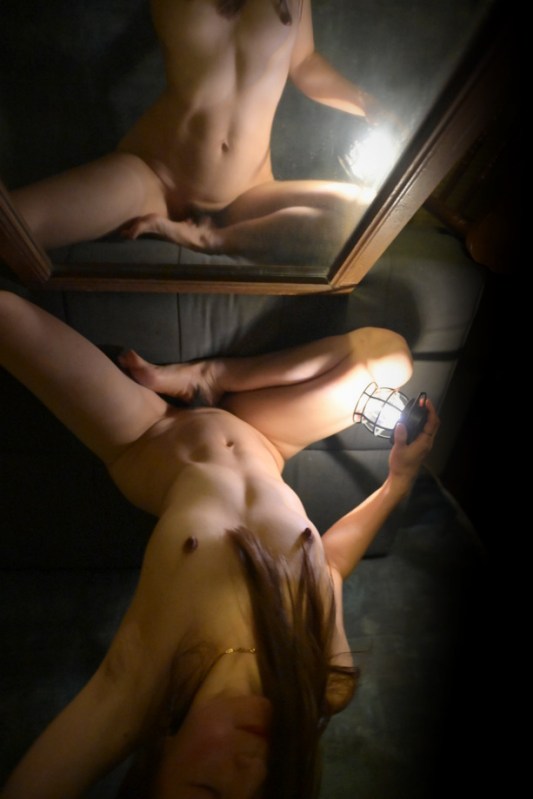
鏡の中の身体
ヌード撮影において鏡が置かれるとき、そこには単なる反射以上の意味が生まれる。鏡は身体を二つにし、見る者の視線を静かに揺らす。目の前にある現実の身体と、鏡の中に現れるもう一つの身体。その二つは同じ存在でありながら、どこか異なる時間と空間に属しているようにも見える。
見る側は、まず自然に実在の身体を見る。しかしすぐに、鏡の中の像にも視線が引き寄せられる。すると視線は行き来し始める。こちらにある身体と、鏡の奥にある身体。その間をゆっくりと往復しながら、観る者はいつしか一つの立体的な空間を感じ取るようになる。
鏡の不思議なところは、普段見ることのできない面をそっと差し出してくれる点にある。背中の曲線や肩の線、腰の微妙な傾きなど、直接の視線では見えない部分が、鏡の中で静かに姿を現す。まるで身体が自分自身の秘密を少しだけ明かすかのようである。
そしてもしモデルが鏡を見つめているなら、その場にはさらにもう一つの物語が生まれる。モデルは鏡の中の自分を見ている。その姿を、私たちは外側から見ている。つまり観る者は、「自分を見る人」を見ているのである。この構図にはどこか静かな内省が漂う。身体は単なる形ではなく、自己と向き合う存在として現れてくる。
鏡を使ったヌード写真を前にすると、見る者の意識はわずかに迷う。どちらが中心なのか、どこに視線を置けばよいのか。その小さな戸惑いが、作品に深みを与える。視線は一つの方向に固定されず、ゆっくりと空間の中を漂う。
そのとき身体は単なる肉体ではなく、一つの風景のように感じられる。光に触れた肌、鏡の奥に広がる静かな空間、そこに重なる人の存在。鏡はただ映しているのではなく、「見るという行為そのもの」を私たちに問いかけている。
だから鏡のあるヌードは、露わにするための装置ではない。むしろ、身体の奥にある静かな時間を映し出すための窓なのである。見る者はその窓の前に立ち、二つの身体の間に生まれる不思議な静けさを、ゆっくりと味わうことになる。
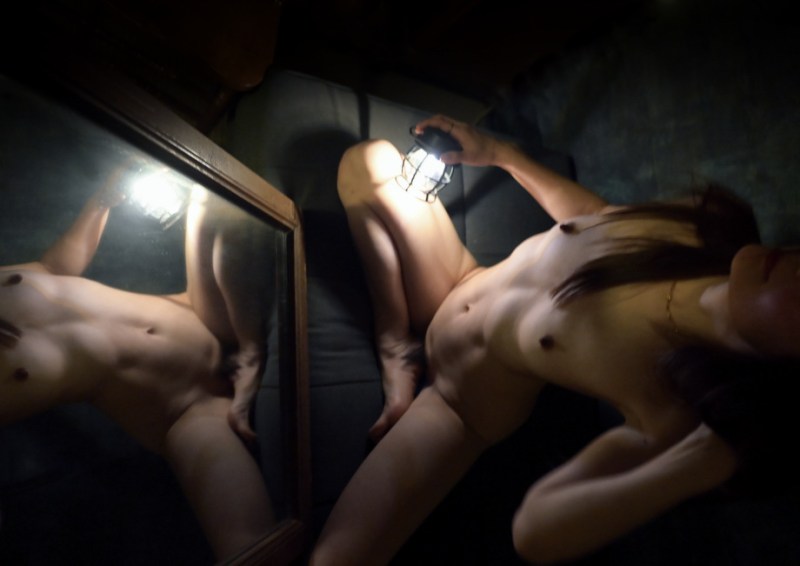
The knowledge and technologies that humanity has accumulated over the course of its long history are now moving toward an era in which much of them will be relinquished. The acts of thinking, calculating, and deriving optimal solutions will increasingly be entrusted to more precise and capable entities. At that point, what will remain for human beings? It is the profoundly fundamental—yet ultimately irreplaceable—realms of “feeling” and “expression.”
The act of feeling is unrelated to efficiency. Even when looking at the same landscape or hearing the same sound, each person’s inner response differs. There is no right or wrong, no superiority or inferiority. There is only an irreplaceable inner tremor that arises in that singular moment. In the past, even such sensations were often tied to evaluation or roles. But in an age where everything is fulfilled, the very act of feeling itself becomes proof of existence.
To express, then, is an attempt to offer that inner tremor to the outer world. Whether through words, sound, the body, or even silence, each becomes a form of expression. Yet expression may not be a technique for skillfully conveying something. Rather, it is an imperfect endeavor to give form—however tenuously—to something vague and elusive within oneself. It is precisely this imperfection that makes human expression truly human.
If the world were to become one in which everything is perfectly reproduced and only optimized expressions abound, then “humanity” would no longer exist within it. For human expression is sustained by hesitation, fluctuation, faltering words, and silence—things that are inefficient and uncertain. To feel and to express are deeply bound to the courage to embrace this uncertainty.
Moreover, to feel is always accompanied by a certain solitude. No matter how many words one uses, it is impossible to fully convey everything one has felt to another. It is precisely because of this gap that people continue to express. Even knowing that it will never fully reach the other, they still offer it outward. Within this exchange, people come to be gently connected.
Ultimately, “to feel and to express” is an act of continuously reweaving the relationship between oneself and the world. What is received from the outside is stirred within, and that stirring is returned outward once again. Within this cycle, one comes to know oneself and, at the same time, continues to encounter others.
If there is an answer to humanity’s final question, it does not exist in any completed form somewhere. It is in the repeated acts of feeling and expressing that answers are constantly born—and just as constantly fade away. That is why we feel, and why we express—not because there is a reason, but because this is the last freedom left to human beings.

 被写体を希望する方々へ